Menu
Book Online

CSL Seqirus (Manufacturer) is experiencing delays with the release of new batches of Q-VAX® Vaccine & Q-VAX® Skin Test. To order Q Fever Skin Test and/or Q Fever vaccine, we have to complete a request form. Once the form has been sent through, the manufacturer would advise of outcome on provision of the vaccine. We then have to order the vaccine for it to be sent to us. This could take 3-4 weeks. Hence an extra pre-vaccination consultation is required. We apologies for any inconvenience caused. Please feel free to contact us if you require any further information. (21st Jan 2026)
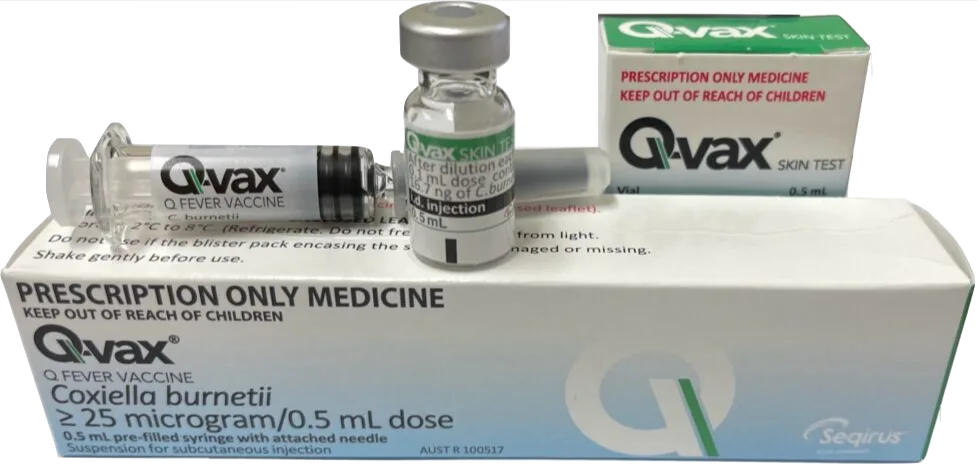
Dr Jay Chelladurai and Dr Cameron Ball offer Q-Fever vaccination at The Surgery, Kincumber. Please ring the surgery on 4369 6777to get more information and book appointment process. Please do not make online appointment. 2 appointments must be made 7 days apart. 1st a long one (30 mins) and the second a standard appointment (15 mins)
Inactivated Coxiella Burnetti
It is a purified suspension of formalin inactivated Coxiella burnetti prepared from the Phase 1 Henzerling strain of the organism grown in the yolk sacs of embryonated eggs. Trace amounts ovalbumin (< 1 mcg) may also be present
Caused by a bacteria called Coxiella burnetii. The bacteria infects domestic and wild animals including cats, dogs, cattle, kangaroos and camels through ticks. The ticks excrete the bacteria in their faeces. Coxiella burnetti can infect humans by inhaling, eating (from handling contaminated objects) as well as through broken skin and mucosa. It can survive at 4oC for more than a month and can survive unto 600C. It can survive in air, soil and dust.
People who have contracted Q-fever can have a spectrum of conditions from being totally unaware of the infection to severe flu like illness but can also affect liver (causing jaundice), affect the heart, cause severe pneumonia needing ICU care. Some people can also have long term illness leading to tiredness, weight loss as well as pain.



We acknowledge the Traditional Custodians of the land on which The Surgery Kincumber stands, the Darkinjung people, and pay our respects to elders past, present and emerging. We recognise Aboriginal and Torres Strait Islander peoples' continuing connection to land, sea and community, and are committed to providing culturally safe and welcoming healthcare for all Aboriginal and Torres Strait Islander patients.
The Surgery Kincumber is committed to providing safe, respectful and inclusive healthcare for all our patients, regardless of sexual orientation, gender identity or expression, or intersex status. We welcome LGBTIQ+ and gender diverse individuals and their families, and are committed to ensuring every person who walks through our door is treated with dignity, respect and without judgement.